- The Road to Autonomy
- Posts
- Supervised is not Autonomous, Autonomous is not Supervised
Supervised is not Autonomous, Autonomous is not Supervised
This Week in The Autonomy Economy

The Road to Autonomy
May 10, 2026
This Week in the Autonomy Economy, investor interest accelerated as the debate over what defines autonomous intensified, just as a political earthquake hit the UK putting both Uber and Lyft’s UK robotaxi plans in the middle of the upheaval.
On May 7th, the UK held local and regional elections. Labour lost Wales for the first time in over a century. Reform UK, led by Nigel Farage, dominated local elections as the Green Party picked up dozens of seats. UK Prime Minister Keir Starmer is now under immense pressure, and the calls for his resignation are growing louder by the day.
While that is the political story, there is also an autonomous vehicle story buried beneath the headlines, and it directly impacts both Uber and Lyft's robotaxi plans for London. Both companies are actively planning to deploy Chinese-made Baidu RT6 robotaxis in London, with Lyft's RT6 arriving in the UK just this week.
Uber and Lyft are preparing to deploy in a market that has dramatically shifted under their feet. The early signs were there, and the historical signs were there as well. Polling data showed Labour underperforming as local political messaging was increasingly anti-China with the ghost of the Huawei ban lurking in the shadows as a precedent. All of the signs appear to have been glanced over for one reason or another.
For the last several years, Mr. Farage has been building the rhetorical case against Chinese connected vehicles on local news and on the campaign trail, calling them spy cars, and mobile listening posts.
Mr. Farage even goes further, arguing that every camera and microphone in a BYD or MG (Owned by SAIC) is a Chinese spy tool, invoking the National Intelligence Law of China to emphasize his point.
With Uber and Lyft both accelerating Chinese-made robotaxi expansion into the UK. After his party’s historic election victory, Mr. Farage has the political leverage to take action. The British people gave him the political leverage, and we expect him to act on it.
As this scenario plays out, we expect the UK Government to mirror past actions against Huawei in a move to restrict Chinese-made robotaxis from being imported and deployed in the UK.
If this scenario were to come to fruition, it would deal a blow to both Uber and Lyft's London robotaxi plans, if protectionist policies take hold and Chinese autonomous vehicles are classified as national security threats and banned from British roads entirely, mirroring past actions against Huawei's 5G network.
Which would raise the question, is an EU ban under the guise of national security next? Or will China’s Autonomous Belt & Road Initiative have already taken hold? Only time will tell.
Both Uber and Lyft made a bet on the Baidu RT6 in London, even as the storm clouds were gathering. The decision they made was in a different political environment than today, but the embers of change were slowly spalling as Uber and Lyft executed their plans.
We first wrote about these emerging risks in our January 4th letter. That was five months ago. Now those risks have come to fruition.

WHAT’S MOVING THE MARKETS | AUTONOMOUS VEHICLES & TRUCKS
Supervised is not Autonomous, Autonomous is not Supervised

Unsupervised Tesla Robotaxi | Source: The Road to Autonomy
The pen is mightier than the sword, and the narrative that takes hold from the pen is far more powerful than the paper it is printed on, or even the reality it describes. Elon Musk has mastered this better than anyone in history since, perhaps, P.T. Barnum.
Both men are great showmen. They understood the market and controlled the narrative despite a barrage of negativity. Both thrived because of it. Perhaps the greatest thing they have in common is the phrase most commonly associated to P.T. Barnum, "Always leave them wanting more." Elon has done this masterfully. Every new release of FSD leaves Tesla drivers wanting more.
With over 10.1 billion miles driven on FSD Supervised, drivers are wanting more. It's not the miles they want, it's Unsupervised that they want, and in typical showman fashion, the exact manner of how that is going to be achieved is never revealed.
But what is revealed is the fact that Unsupervised is coming, and that keeps them wanting more. While Unsupervised is not available in personally owned Tesla vehicles yet, it is available in the form of Robotaxi in Austin, Dallas, and Houston.
No driver, no in-vehicle observer, no fancy wordsmithing, just purely autonomous. Which brings us to the definition debate. What defines autonomous? What defines driverless? What defines self-driving?
To us, the answer is rather simple. Autonomous, Driverless, and Self-Driving are all defined by one common metric. No safety driver. No human observer behind the wheel or in the passenger seat. Those are supervised, in the same way that FSD engaged today is supervised.
If you ride in a Tesla from New York to California and never touch the wheel, but you are sitting behind the wheel, you are responsible in the event of an incident. It is supervised.
If you ride in an autonomous truck from Dallas to Houston and there is a human in the cab with the ability to intervene, it is supervised. It is not autonomous, even if you never touched the wheel. It's supervised, because you had the ability and the legal responsibility to take over if an incident were to occur.
Today in the United States, only two companies are operating 24/7 under our definition of autonomous. Waymo and Kodiak. Waymo is operating autonomous robotaxis in multiple cities around the United States 24/7. Kodiak is operating in the Permian Basin 24/7, hauling fracking sand dynamically routing different oil wells, in similar fashion to how you tell your robotaxi where you want to go.
We were in the Permian a few weeks ago and inspected the trucks, and a full field report will be released on Monday, May 18th showing you exactly what we saw in the Permian. There was no human observer. They were fully autonomous.
Then there is Tesla, which is operating Unsupervised Robotaxis in Austin, Dallas, and Houston without drivers, with limited hours, alongside Zoox in San Francisco and Las Vegas. The common denominator between these deployments is that they are autonomous. No human in the vehicle or the truck.
That is the definition of autonomous. When a human is present, it is not autonomous. It is supervised, despite what the narrative is trying to tell you.
Next time you read a headline about autonomous, driverless, or self-driving, ask yourself one question. Is there a safety driver or an observer onboard? If yes, it is not autonomous. It is supervised.
Our Take: None of us can have as many virtues as the fountain-pen, or half its cussedness; but we can try. - Mark Twain
Companies Mentioned: $GOOGL ( ▲ 0.42% ) , $TSLA ( ▼ 0.74% ) , $AMZN ( ▲ 1.19% ) , $KDK ( ▼ 0.29% )
AUTNMY AI | SPONSORED
Intelligence for the autonomy economy
Right now, somewhere, a company
is making a move in plain sight.
The Street reads the headline.
AUTNMY AI sees the signal.
Will you?
Qualitative intelligence
generates alpha.
AUTNMY
AI
Your models. Our intelligence.
Learn MorePIQUING OUR INTEREST
Private Markets Interest in the Autonomy Economy Heats Up Since the start of the year, $23.6 billion in private capital has been invested in companies developing autonomous driving technologies, compared to $10.18 billion in all of 2025, with Waymo commanding 68% of all of the capital to date.
Nuro Secures CPUC Permit In the land of over-regulation, Nuro has secured a permit from the California Public Utilities Commission (CPUC) that will allow the company to carry passengers in test vehicles with safety drivers.
Serve Robotics Grows LA Fleet to Over 500 Delivery Bots Serve Robotics has scaled from two LA neighborhoods in 2023 to more than 500 sidewalk delivery robots across 40 neighborhoods.
Kodiak AI and General Dynamics Land Systems to Develop Autonomous Ground Vehicles The trend of dual-use continues as Kodiak announced a partnership with General Dynamics Land Systems to jointly develop autonomous ground vehicles for military applications.
Kodiak Heads to Canada, Expands into Logging Building on the success of their off-road business in the Permian Basin, Kodiak is now expanding to Alberta, Canada, where the company will enter the logging industry in partnership with West Fraser.
Aurora Unveils International Truck As Aurora prepares to deploy International trucks, the company unveiled the design in an X post.
Lyft's Baidu RT6 Robotaxis Arrive in London, Begin Mapping Baidu's RT6 robotaxis are now in London and have begun mapping operations as Lyft prepares to put them on the network in the back half of the year, just as UK politics undergo a major upheaval.
Rivian Looks to China In an odd and extremely risky move, given the current state of geopolitics, Rivian is considering making its own in-house LiDAR in partnership with a Chinese firm.
10 Years to Achieve Autonomous Driving’s ChatGPT Moment That is according to WeRide CEO Tony Han Xu, who believes the first L5 autonomous vehicles will arrive by 2035, while we question if L5 will ever happen.
📰 Follow @RoadToAutonomy on X for our latest thoughts and insights on the autonomy economy.
SOCIAL BUZZ | HUMANOIDS
Soon You Might Never Have to Make Your Bed Again
It is only a matter of time until humanoids enter domestic service in homes around the world. One of the many use cases will be making the bed each morning. While there is a lot of hype surrounding the humanoid market, the market is also expanding rapidly as larger names begin to consolidate smaller startups.
One of those names is Meta, as the company appears to have ambitions to build the Android of humanoids following the acquisition of Assured Robot Intelligence (ARI).
AUTNMY AI's OMEGA uncovered the early signals, and Grayson Brulte and Rob Grant discussed them on Autonomy Signals this week. You can watch that section of the podcast here.
ARI co-founder Lerrel Pinto joined us on The Road to Autonomy podcast last November. You can watch that podcast here.
Our take: We are still in inning one of the evolution of humanoids.
Companies Mentioned: $META ( ▼ 2.1% )
FIELD REPORT
Tesla Unsupervised Robotaxi Houston Field Report

(May 6, 2026) After spending an afternoon in Houston riding in a Tesla Unsupervised Robotaxi and conducting depot reconnaissance at the Tesla service center on Hempstead Highway, we identified several operational shifts that distinguish this market from Austin.
Watch on YouTube | Read the Field Report
AUTONOMY SIGNALS PODCAST
Tesla Scales Unsupervised Robotaxis, Wisk Doubles Fleet, Meta Aspires to Build the Android of Humanoids

(May 8, 2026) This week on Autonomy Signals, Grayson Brulte and Rob Grant discuss Tesla's Unsupervised Robotaxi expansion to Dallas and Houston, Wisk Aero doubling its Gen 6 flight test fleet, and Meta's acquisition of Assured Robot Intelligence.
AUTONOMY MARKETS PODCAST
Vegas Field Report and Autonomous Trucking Earnings
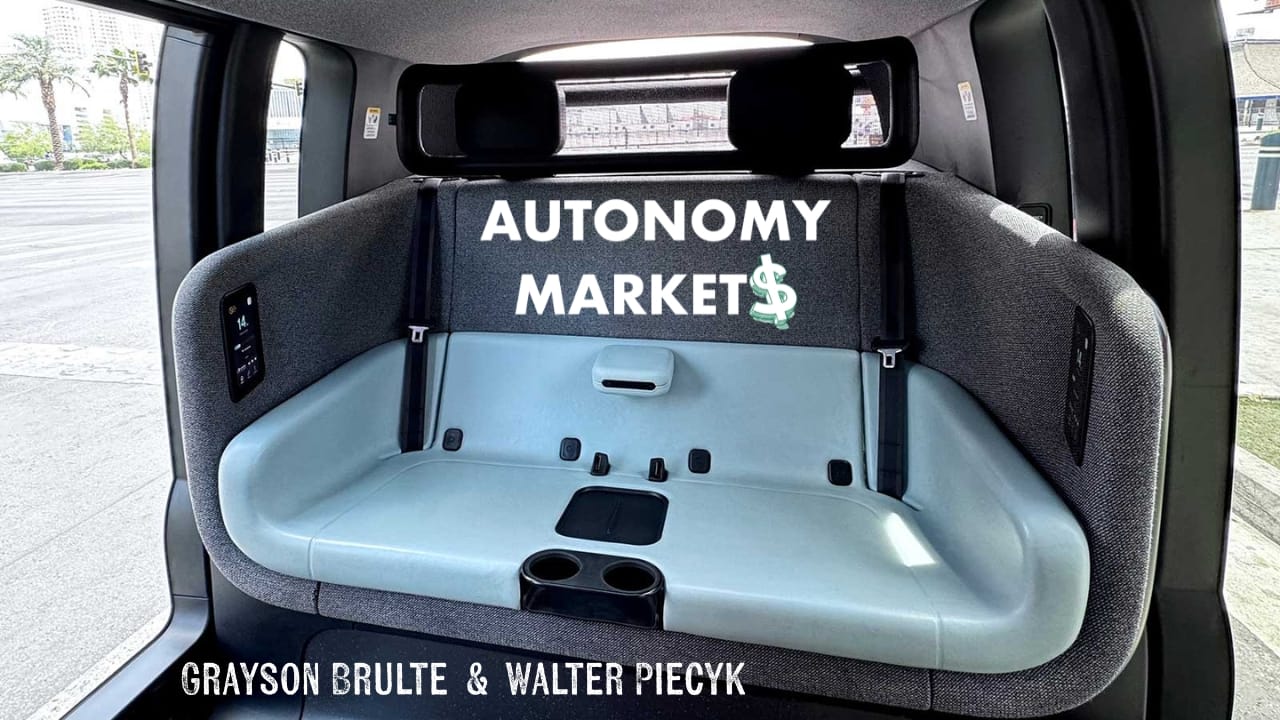
(May 9, 2026) This week on Autonomy Markets, Grayson Brulte and Walter Piecyk discuss Grayson’s Las Vegas field work riding in Zoox and Motional robotaxis, Uber’s earnings and the path to driver-out, and autonomous trucking earnings.
The Road to Autonomy® is an applied intelligence platform owned and operated by AUTNMY AI, Inc. All content, including market intelligence and the AUTONOMY LEADERBOARD, is provided for informational and educational purposes only. AUTNMY AI, Inc. is not a registered investment adviser, broker-dealer, or financial planner, and does not provide financial, legal, or tax advice. Nothing herein constitutes a recommendation to buy or sell any security or financial product. All investments involve risk. Content is provided "as is" and is subject to change without notice. Unauthorized reproduction or distribution, including the use of this content for training large language models (LLMs) or generative AI systems, is strictly prohibited without prior written consent.